
Where to store my money in the Czech Republic?

I’m sure we’ll all agree that 2020 has been such a challenging year for everyone. So challenging that I completely forgot to write to a whole year, my apologies 😀 But now I’m here to tell you what have changed this year.

With recessions hitting almost every single country out there, Czech Republic isn’t an exception. The CNB (Czech Cental Bank) decided to keep the interest rate low, hence banks slashed their interest rates to the extreme (now most banks offer below 1% of interests). So unless you need to use your money immediately (like to buy a flat or something), this makes it even less attractive to just put your money in a bank. Therefore naturally, I was looking for alternatives of where to put my money.

My first option was the stock market. I’ve been regularly investing into the stock market for a while now, but the stock market took a major hit sometime in February – March. I know it was very scary to see how I put all my bonuses from work into the stock market in February, and the next week it dropped so hard my stomach churned. But luckily, I was shocked only for a while, then I decided to keep on investing every month. To my surprise, now it’s pretty much gone back to where it was before the crisis. In fact, if you kept investing throughout the dip like I did, you should’ve been making some sweet profits by now already. This is only my first recession so with this experience, and I guess by taking into account anyone’s experiences going through recessions, the lesson learned is to just keep on going no matter how bad the stock market goes because eventually, it will go back up again (especially for those who are in it for the long run). (I’m using Degiro as my broker to regularly by ETF with free commission, and Revolut to buy individual stocks. I’ve added referral links so you could get free €20 from Degiro and a free card from Revolut if you decided to join).

That should be a better alternative already. However, if you’re like me, always wondering if there are more alternatives just to diversify your portfolio, Cryptocurrency could be your answer too. Many of you have noticed how Bitcoin has been brought up in the mainstream media recently due to its price soaring (nearly $20,000 this year). And because of that, more and more people are interested to tap into this hoping to get rich quickly. However, if you decide to try buying this, please bear in mind that cryptocurrencies are much more volatile than the stock market, and many people say you should only invest the amount of money you are prepared to lose.

If after reading this you still think that’s a thing for you, I will congratulate you because I believe in the future, cryptocurrencies would be used and utilised by way more people due to its nature (decentralised, easy to use and quick). And you can keep on trading them even on weekends, unlike the stock market. (I’m using Crypto.com and Celcius to buy and hodl my crypto assets. Again I added referral links so you could get free $50 (browser) and $25 (app) from Crypto-com and $20 in Bitcoin from Celcius).

Those are some alternatives you could use to store your money if you want to avoid habing your money being eaten away by inflation. Hope this helps and let me know in the comment what you do to manage your money! -AB

Review: Curve Card

Here I’ve talked a bit about finding the cheapest way to travel, and recently I’ve found another, and so far the cheapest and the best, way to travel; using a Curve card.

Curve Card

Essentially, Curve card is a Mastercard issued by a UK based fintech, that is basically combining all your cards into one. This alone should be beneficial already, especially for people like me who have more than 1 bank cards used for different purposes. Now instead of carrying 3 or 4 cards or more, just carry 1 Curve card and you can choose in their app which card you want to use for a purchase. Another cool thing from them is they offer a ‘Go Back in Time’ feature, which means if you’ve used one card for one purchase and decided to use another card instead, you can just activate this feature and voila, your purchase will be transfered to the other card you wish. This is extremely useful when for instance, you want to charge your work card instead of your personal card.

Is that it? Absolutely not. Curve card is also great for traveling since you only need to carry 1 card instead of all your cards, and, it comes with a killer exchange rate! Recently I went on a holiday and I used my Curve card and my normal credit card from my bank and the difference on the exchange rate alone was enough to get me 2 meals in a restaurant. The exchange rate was only slightly worse than Transferwise but with a much simpler way (you don’t need to top up anything, Curve card will charge your cards directly), I’d pick Curve card any day.

An extra benefit for me is how my credit card gives 1% cashback for every time I spend abroad and online. Every purchase through Curve card is considered an online transaction, since Curve is charging your bank instead of the original merchant. This makes all my purchases, even if it’s not online/abroad, eligible for the 1% cashback program.

Curve card comes with different packages and pricing options. I’m using the free one since I don’t travel that often, and even using the free option, you get £200 free withdrawals monthly (even when you’re charging your credit cards!). There’s also a promotional 1% cashback from 3 merchants of your choice (only for 3 months for the free option).

I had an issue with withdrawal when I was abroad and their support was extremely responsive and helpful. I’ve been using this card for 2 months now and I could only give good reviews. But also pay attention to their terms & conditions as they charge extra on weekends.

If you want to use a Curve card as well, you can download the app and use this promo code DP9K349N where we will both receive £5.

Credit Cards in Czech Republic

For years I’ve lived here in Czech Republic, I noticed that Czech people are generally against using credit cards. I understand, credit cards aren’t for everyone, especially those who have a hard time controlling their spendings. But if used correctly and wisely, credit cards can actually bring you some extra money.

One thing to keep in mind before using a credit card is to understand that credit cards aren’t an extra income. It is a form of loans, which means if you don’t pay off everything you owe, there will be interests you need to pay. I would only recommend using credit cards if you can pay off everything every month, so you won’t stock up some debts.

For me personally, I started using credit cards because I wanted to manage my cashflow. There are times when I need to make big purchases, be it for work or personal use, and I want to ‘spread’ out my spendings as to not have spikes in my monthly cashflows. However, if you’re an expat here and don’t have permanent residency, finding the right bank that would issue you a credit card is another tricky part. Most banks require you to at least have a PR first. Luckily for me, I’ve been banking with ÄŒeská spoÅ™itelna and they had no problem issuing one to foreigners.

Using the card is free as long as you spend minimum 3,000Kc monthly, which isn’t all that difficult to do. You get a card for free and could also get an extra one if you want. An extra benefit for me was that ÄŒeská spoÅ™itelna was charging 100Kc monthly, and this was reduced by 50Kc if you receive 7,000Kc in your account (I got my salary to this account so this wasn’t a problem), and further 50Kc if you use another product from them, so using their credit card brought my banking expenses with them to 0.

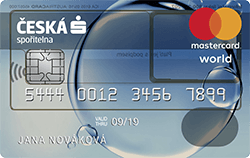
A standard credit card from ÄŒeská spoÅ™itelna is a Mastercard World credit card, which is considered a ‘premium’ credit card. This means, there are some perks you could enjoy just by owning this card, one of which is free entry to airport lounges in Vienna Airport and reduced price to Mastercard airport lounge in Prague airport (350Kc per entry, or 100Kc if you’re registered to the Priceless Specials program).

Another thing I like from using this card is the 1% cashback program if you spend online or abroad (max. 350Kc). Buying airline tickets, booking hotels, or even paying Netflix or Spotify subscriptions then entitle me to get 1% cashback. I have another trick to maximize this 1% cashback program, but I will write it in a separate article.

Again, I pay off all my credit card debts every month, so credit cards for me has only brought benefits so far. It might not seem like much, but using credit cards, especially one from CS, has been bringing me some extra cash at the end of the month, and also I could enjoy some free snacks/drinks whilst waiting at airports.

Disclaimer: Things I write here are coming from personal experiences. I am not a professional financial advisor and I am not paid to promote any products by any banks.

Traveling Around: What is the Cheapest Way?

One of the best things of living in Czech Republic is how easy it is so to get around. Just in a couple of hours, you will be in another country already. But since Czech Republic is not yet in the Euro Zone, you will need to prepare money in another currency. What’s the cheapest way to do so?

Traveling around from Czech Republic is easy

Traditionally, you can always go to exchange your money in some money changer. But there are other more convenient ways that will end up saving you more Koruns at the end of the day. Here are some ways to do so:

1. Open a foreign currency account for free in your Czech bank

All you need to do is arrange a foreign currency account (most commonly, EUR account), link it to your card, and you’re good to go. You can just top it up and use your card abroad, they won’t charge your CZK account for that.

2. Rewards when you use your bank cards abroad

ÄŒeská spoÅ™itelna offers 1% cashback when you use their credit card abroad/online. Hello bank credit card also has similar cashback offer although it is not only limited to spending abroad or online. mBank through their mBank World card also offers similar program. However, the problem with this is banks’ exchange rates are normally even worse than traditional money changers that getting 1% cashback won’t make your journey any cheaper, although indubitably much easier.

3. Withdraw money

Some banks let you withdraw money abroad for free or for a simple fee. Simple and easy, although the problem of banks’ exchange rates remains.

4. My most favourite: Get a Travel Card

These days, there are many providers like Transferwise, Revolut, Bunq, or N26 that offer multi-currency accounts with real exchange rates (like when you Google), plus a small fee, or a Curve card. This is a much cheaper way of making foreign transactions without having to deal with cash in hand (although normally, you get free withdrawals up to a certain amount each month). I’ve been traveling with a travel card for a while now, and it is definitely much cheaper than any of the options above (I’ve done all).

How to choose the best travel card will be talked about more in depth in another post.

Hope this helps you manage your traveling budget. Enjoy your travel!