
Where to store my money in the Czech Republic?

I’m sure we’ll all agree that 2020 has been such a challenging year for everyone. So challenging that I completely forgot to write to a whole year, my apologies 😀 But now I’m here to tell you what have changed this year.

With recessions hitting almost every single country out there, Czech Republic isn’t an exception. The CNB (Czech Cental Bank) decided to keep the interest rate low, hence banks slashed their interest rates to the extreme (now most banks offer below 1% of interests). So unless you need to use your money immediately (like to buy a flat or something), this makes it even less attractive to just put your money in a bank. Therefore naturally, I was looking for alternatives of where to put my money.

My first option was the stock market. I’ve been regularly investing into the stock market for a while now, but the stock market took a major hit sometime in February – March. I know it was very scary to see how I put all my bonuses from work into the stock market in February, and the next week it dropped so hard my stomach churned. But luckily, I was shocked only for a while, then I decided to keep on investing every month. To my surprise, now it’s pretty much gone back to where it was before the crisis. In fact, if you kept investing throughout the dip like I did, you should’ve been making some sweet profits by now already. This is only my first recession so with this experience, and I guess by taking into account anyone’s experiences going through recessions, the lesson learned is to just keep on going no matter how bad the stock market goes because eventually, it will go back up again (especially for those who are in it for the long run). (I’m using Degiro as my broker to regularly by ETF with free commission, and Revolut to buy individual stocks. I’ve added referral links so you could get free €20 from Degiro and a free card from Revolut if you decided to join).

That should be a better alternative already. However, if you’re like me, always wondering if there are more alternatives just to diversify your portfolio, Cryptocurrency could be your answer too. Many of you have noticed how Bitcoin has been brought up in the mainstream media recently due to its price soaring (nearly $20,000 this year). And because of that, more and more people are interested to tap into this hoping to get rich quickly. However, if you decide to try buying this, please bear in mind that cryptocurrencies are much more volatile than the stock market, and many people say you should only invest the amount of money you are prepared to lose.

If after reading this you still think that’s a thing for you, I will congratulate you because I believe in the future, cryptocurrencies would be used and utilised by way more people due to its nature (decentralised, easy to use and quick). And you can keep on trading them even on weekends, unlike the stock market. (I’m using Crypto.com and Celcius to buy and hodl my crypto assets. Again I added referral links so you could get free $50 (browser) and $25 (app) from Crypto-com and $20 in Bitcoin from Celcius).

Those are some alternatives you could use to store your money if you want to avoid habing your money being eaten away by inflation. Hope this helps and let me know in the comment what you do to manage your money! -AB
Credit Cards in Czech Republic

For years I’ve lived here in Czech Republic, I noticed that Czech people are generally against using credit cards. I understand, credit cards aren’t for everyone, especially those who have a hard time controlling their spendings. But if used correctly and wisely, credit cards can actually bring you some extra money.

One thing to keep in mind before using a credit card is to understand that credit cards aren’t an extra income. It is a form of loans, which means if you don’t pay off everything you owe, there will be interests you need to pay. I would only recommend using credit cards if you can pay off everything every month, so you won’t stock up some debts.

For me personally, I started using credit cards because I wanted to manage my cashflow. There are times when I need to make big purchases, be it for work or personal use, and I want to ‘spread’ out my spendings as to not have spikes in my monthly cashflows. However, if you’re an expat here and don’t have permanent residency, finding the right bank that would issue you a credit card is another tricky part. Most banks require you to at least have a PR first. Luckily for me, I’ve been banking with Česká spořitelna and they had no problem issuing one to foreigners.

Using the card is free as long as you spend minimum 3,000Kc monthly, which isn’t all that difficult to do. You get a card for free and could also get an extra one if you want. An extra benefit for me was that Česká spořitelna was charging 100Kc monthly, and this was reduced by 50Kc if you receive 7,000Kc in your account (I got my salary to this account so this wasn’t a problem), and further 50Kc if you use another product from them, so using their credit card brought my banking expenses with them to 0.

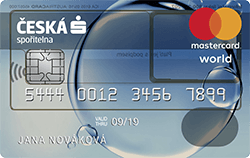
A standard credit card from Česká spořitelna is a Mastercard World credit card, which is considered a ‘premium’ credit card. This means, there are some perks you could enjoy just by owning this card, one of which is free entry to airport lounges in Vienna Airport and reduced price to Mastercard airport lounge in Prague airport (350Kc per entry, or 100Kc if you’re registered to the Priceless Specials program).

Another thing I like from using this card is the 1% cashback program if you spend online or abroad (max. 350Kc). Buying airline tickets, booking hotels, or even paying Netflix or Spotify subscriptions then entitle me to get 1% cashback. I have another trick to maximize this 1% cashback program, but I will write it in a separate article.

Again, I pay off all my credit card debts every month, so credit cards for me has only brought benefits so far. It might not seem like much, but using credit cards, especially one from CS, has been bringing me some extra cash at the end of the month, and also I could enjoy some free snacks/drinks whilst waiting at airports.

Disclaimer: Things I write here are coming from personal experiences. I am not a professional financial advisor and I am not paid to promote any products by any banks.

Czech Money

I’m not gonna lie, the first Czech word I learned when I first came here nearly 4 years ago was Peníze aka money. I was driving with my manager at that time and saw this huge billboard from a bank with the word Peníze in it and I thought it was hilarious (but I obviously thought of something else).

Back then I just moved here from Indonesia because of a job, and just like everyone else who is new to a country, I needed to get my paperwork done, get a new SIM card, set up a bank account, etc. I did everything based on a recommendation from a friend I just met, not knowing anything including the language or the market, and definitely didn’t do any research. I want to make things easier for you.

Czech Money

Although Czech Republic has joined the European Union since 2004, it is still outside of the Euro Zone until today, which means the Czechs still have not used Euro like their lovely neighbour slash ex-partner Slovakia. I personally think it’s better this way because it makes things cheaper somehow (but of course not as convenient to travel to neighbouring countries). But either way, here people use the Czech Crowns (koruna, Kč, CZK).

There are 100, 200, 500, 1000, 2000, and 5000 CZK banknotes and 1, 2, 5, 10, 20, and 50 CZK coins, maybe click here for more info. 1 EUR is roughly about 25 CZK (1 GBP ≈ 28 CZK, 1 USD ≈ 22 CZK, 1 CAD ≈ 17 CZK). Euro is more or less accepted in big places, but firstly you will receive changes in Crowns and secondly, you will pay more in Euro than in Crown (for example if you’re shopping in Albert or Billa, they would take 1 EUR for about 24 CZK). So get your Crowns ready when you’re coming to Czech Republic!